Late-night cravings rarely come from true physical hunger. They are usually driven by short sleep, stress hormones, ingrained habit loops and simply not eating enough during the day. Once you understand the “why,” the “how” becomes far easier — and you stop relying on willpower alone, which tends to fail late at night when you are tired.
Quick answer: Eat enough protein and fiber during the day, keep a consistent eating window, wind down without the TV-and-snack habit, and find non-food evening pleasures. Better sleep is the secret weapon.
Why cravings spike at night
- Under-eating by day. If your daytime meals are too small or skipped, your body simply asks for fuel at night to catch up.
- Poor sleep. Too little sleep raises ghrelin, the hunger hormone, which fuels next-day cravings and creates a vicious circle.
- Stress and cortisol. After a mentally draining day, cortisol can stay elevated, and the brain seeks quick comfort and energy through food.
- Dopamine and reward. Sugary, fatty foods trigger a dopamine hit — the brain’s reward signal — and it learns to repeat the behavior.
- Habit loops. The pattern of couch + screen + relaxation gets wired to “snack time,” so the cue alone makes you reach for food.
The daytime half of the fix
Most night-time cravings are actually decided earlier in the day. Set yourself up well and the evening becomes much easier to manage.
- Start with a protein-rich breakfast. A higher-protein morning meal has been shown to reduce cravings later in the day.
- Balance every meal. Combine protein, fiber and healthy fat so you stay full and satisfied for longer.
- Do not under-eat. Steady, adequate meals prevent the evening rebound binge that comes from daytime restriction.
- Keep regular meal times. Irregular eating confuses your hunger signals and disrupts your circadian rhythm.
The evening routine that breaks the cycle
| Time | Step |
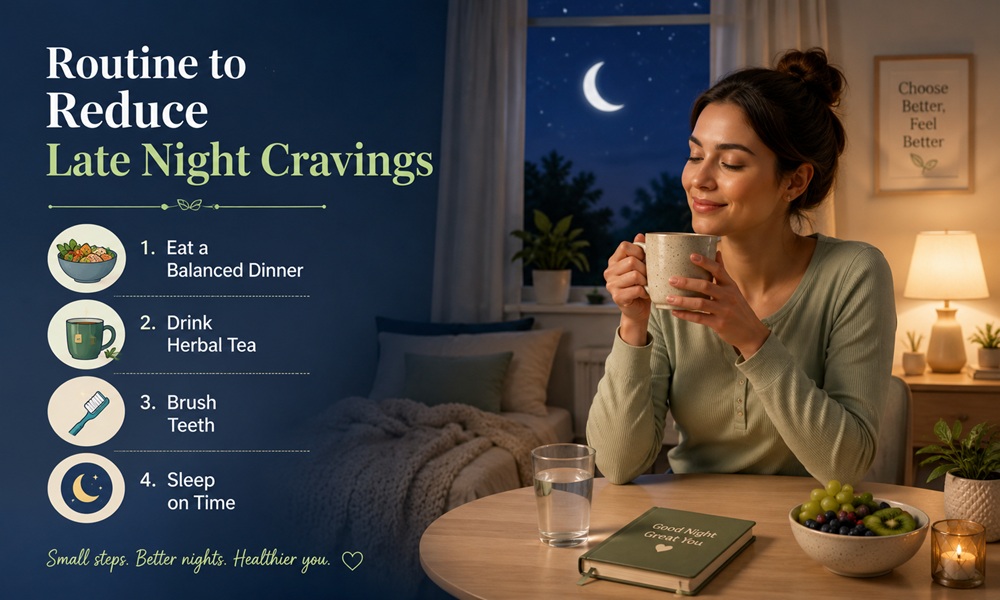
| After dinner | Have a small, satisfying close to the meal so your brain registers that eating is done |
| Wind-down | Swap the “couch + snack” combo for a new activity — a walk, reading, a hobby, a bath |
| When a craving hits | Pause and ask yourself: am I hungry, stressed, bored, or just on autopilot? |
| If stressed | Try breathing, music, or a short stretch before turning to food |
| If truly hungry | Choose a protein or fiber snack rather than a quick sugar hit |
| Pleasure | Build small, non-food pleasures into your evening on purpose |
Hunger vs. false hunger
Behavioral scientists distinguish true physical hunger from what they call “false hunger” — the emotional or habitual pull toward food. Physical hunger builds gradually and will accept almost any food. False hunger tends to be sudden, very specific (usually for something sweet or salty) and tied to a mood or a moment, like sitting down in front of the TV. Learning to spot the difference is one of the most powerful skills for managing evening eating.
Smart late-night snacks (if you do eat)
A light, balanced snack is perfectly fine — the goal is to avoid large, mindless, sugar-heavy grazing. If you are genuinely hungry, reach for these:
- Greek yogurt with a few berries
- A small handful of nuts
- Cottage cheese or a boiled egg
- Vegetable sticks with hummus
- A piece of fruit with a little nut butter
When it is more than a habit
Regularly eating a large share of your daily calories after dinner, along with waking at night to eat, can reflect a pattern known as night eating syndrome. If late eating feels out of your control or consistently disrupts your sleep, it is worth talking to a professional. This topic can also touch on disordered eating — if your relationship with food feels distressing, please know that support is available, and a clinician can help you find the right resources.
Frequently Asked Questions
Why do I crave sugar at night specifically?
Low daytime intake, tiredness and built-up stress all push the brain toward quick energy. Sugar also delivers a fast dopamine reward, which the nightly habit reinforces over time.
Does better sleep reduce cravings?
Yes. Adequate sleep lowers the hunger hormone ghrelin and improves self-control, which together make cravings far easier to manage the next day.
Is it bad to eat at night?
A light, balanced evening snack is fine. The real issue is frequent, large, mindless snacking that disrupts sleep and adds excess calories without satisfying you.
How do I stop the TV-snacking habit?
Change the cue. Move your snacking away from the screen, keep tempting foods out of easy reach, and replace the routine with another relaxing activity so the couch no longer signals “eat.”
For general education. If your eating patterns cause distress or feel out of control, please reach out to a qualified professional.